Tip Out Calculator: How Restaurants Split Tips Fairly
Closing a shift should end with clear numbers, not a group chat argument. Guests tip servers; support staff set tables, run food, pour drinks, and seat the room. A written tip-out or tip-pool policy — plus a free tip out calculator — turns policy into dollars anyone can verify on a phone.
This guide is for servers checking a checkout sheet, managers standardizing a house policy, and bartenders who want to see how bar tip-outs and pools actually cash out. You will get definitions, the three formulas most restaurants use, full worked examples, role percentage ranges, and how to avoid common math mistakes.
End-of-shift tip math without the spreadsheet fight
Tip out by %, pool by hours, or points × hours — free, private, mobile-friendly.
Tip Out vs Tip Pool vs Tip Credit
People mix these terms. They answer different questions:
- Tip out: A server (or other tip earner) pays fixed percentages from their tips or from a sales base to named support roles. The server usually keeps the remainder of their own tips after those transfers.
- Tip pool: Eligible tips for a shift or section are combined and redistributed by hours, points, or another formula so floor and support share one pot.
- Tip credit (wage law): A payroll concept that can affect minimum wage when employers take a tip credit. It is not the same as calculating how much busser gets from tonight’s envelopes. This article does not give wage-law advice.
Some houses use both: servers tip out bar before the remaining tips (or a floor pool) redistribute by hours. Write the order of operations in the handbook so nobody double-counts.
What Guests Actually Search For
If you are reading this mid-shift, you probably want one of these answers:
- “How much do I tip out?” — Apply your house % lines to the correct tip or sales base, sum the lines, and subtract from tips.
- “How do we split the tip jar / pooled cards?” — Divide the pool by hours or by points × hours.
- “Is our tip out fair?” — Math fairness is transparency: same base, same formula, same roles every night, visible totals.
Three Formulas That Cover Most Restaurants
The free restaurant tip split calculator supports all three modes. Use the formula that matches your written policy — not the one that looks largest tonight.
1. Percentage tip outs (most common)
Sum every role. Server keeps:
Confirm whether the tip base is cash + card tips, food sales only, liquor sales, or net after voids. Swapping bases mid-policy is how “fair” systems turn into fights.
2. Hours pool
Simple and easy to audit when everyone in the pool has a similar role. Double-open shifts, early cuts, and training doubles still need clear clock rules.
3. Points × hours pool
Points weight roles (e.g. server 1.0, busser 0.5, bar 0.8). Two people with the same hours get different dollars if their points differ. Publish the point chart with the policy.
End-of-shift tip math without the spreadsheet fight
Tip out by %, pool by hours, or points × hours — free, private, mobile-friendly.
Worked Example: $420 Tips, Percentage Tip Outs
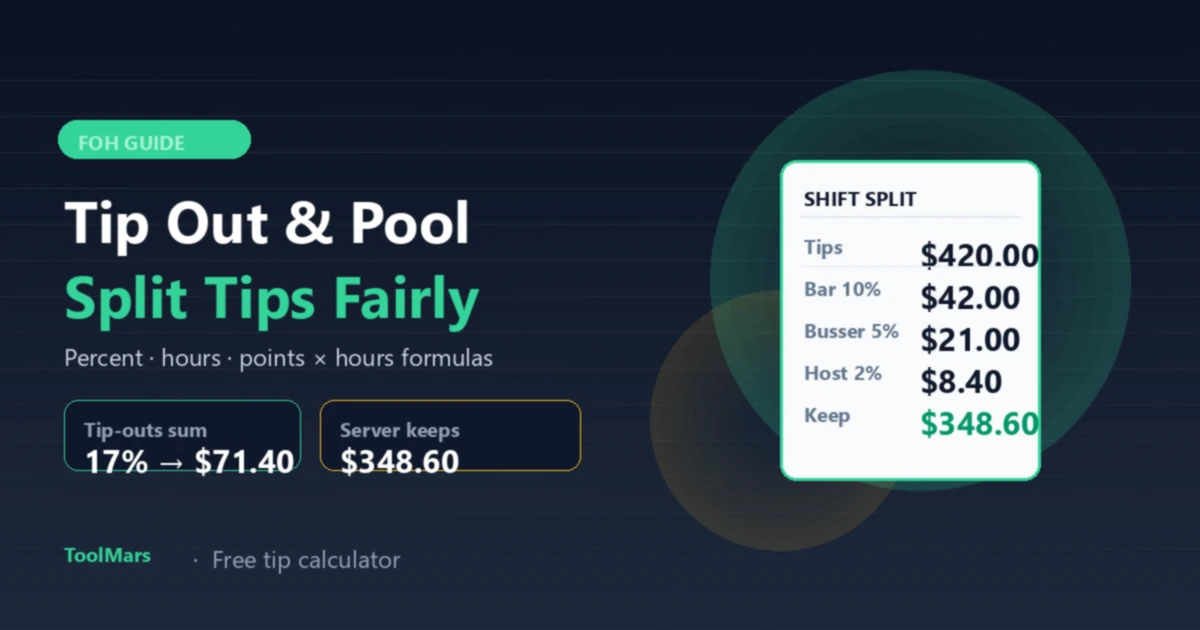
House policy: of total tips, 10% bartender, 5% busser, 2% host. Server nets $420 before tip-outs.
| Role | % | Math | Dollars |
|---|---|---|---|
| Bartender | 10% | 420 × 0.10 | $42.00 |
| Busser | 5% | 420 × 0.05 | $21.00 |
| Host | 2% | 420 × 0.02 | $8.40 |
| Total tip-outs (17%) | $71.40 | ||
| Server keeps | $348.60 | ||
If policy is “10% of liquor sales” instead of “10% of tips,” replace the $420 base for that line only. Mixing bases line-by-line is allowed — mixing them by accident is not.
Worked Example: $600 Pool Split by Hours
Pooled tips for the night: $600. Clocked in the pool: Alex 8h, Jordan 6h, Sam 8h, Riley 7h → 29 total hours.
- Alex: 8/29 × 600 ≈ $165.52
- Jordan: 6/29 × 600 ≈ $124.14
- Sam: 8/29 × 600 ≈ $165.52
- Riley: 7/29 × 600 ≈ $144.83
Round pennies in one consistent direction (manager cash-out sheet is the source of truth) so the last person is not short a dollar every night.
Worked Example: Same $600 with Points × Hours
Points: servers 1.0, busser 0.5, bar 0.8. Units = points × hours.
| Person | Pts × hrs | Units | Share of $600 |
|---|---|---|---|
| Alex (server) | 1.0 × 8 | 8.0 | ≈ $205.13 |
| Jordan (server) | 1.0 × 6 | 6.0 | ≈ $153.85 |
| Sam (busser) | 0.5 × 8 | 4.0 | ≈ $102.56 |
| Riley (bar) | 0.8 × 7 | 5.6 | ≈ $143.59 |
| Total units | 23.6 | $600.00 | |
Compared with pure hours, servers gain and Sam’s lower point rate pulls busser pay down. That is intentional if the house values floor tips higher per hour — and a problem if nobody agreed to those points. Run the points mode next to hours mode when changing policy so the whole team sees the delta.
Typical Server Tip Out Percentage Ranges
Charts online are not law and often describe full-service American concepts. Treat them as conversation starters when you are drafting a policy — never override the handbook on a busy Friday.
- Bartender: often 5–15% of tips or a % of liquor / beverage sales when bar runs drinks for the whole floor
- Busser / SA: often 1–5% of tips or food sales
- Host / expo / runner: often 1–2% each when those roles are in the tip-out list
- Total tip-outs: many houses land between about 10% and 25% of server tips combined — high-end or drink-heavy concepts can sit higher
Fine dining, ghost kitchens, counter service with QR tips, and coffee bars all break “industry average” charts. Match competitor norms in your segment and your labor model, not a generic average from social media.
Tips Base, Sales Base, or Both?
- Tips-based: easy to explain (“of what you earned”). Support suffers when guests tip poorly even if the section was slammed.
- Sales-based: ties tip-outs to volume. Needs POS reports the whole team trusts and clear rules for comps, employee meals, and takeout.
- Hybrid: e.g. bar on liquor sales, busser on food tips. Document each line’s base in one table.
Common Mistakes That Spark Drama
- Percent of net after tip-outs when policy said % of gross tips (or the reverse). Always define gross vs net.
- Double-dipping: bar tip-out from servers and a separate full share of the same dollars in a pool without a write-up of the order of ops.
- Hours without breaks / training: inconsistent “who is in the pool” and late arrivals counted as full doubles.
- Over-100% tip-outs: role lines that sum past 100% of tips leave nothing for the server — the calculator flags this so you fix policy math before cash-out.
- Card vs cash blur: pooling only cash while cards stay siloed without a clear reason.
Not legal or payroll advice. Tip credit, mandatory pools, service charges vs tips, and who may participate depend on federal and state or provincial rules and change over time. Managers should keep written policies, accurate records, and confirm compliance with employment counsel or a restaurant-savvy payroll partner.
Manager Checklist for a Policy People Can Live With
- One page: who is in, tip base per role, % or points chart, cash-out order, and exceptions (private dining, large parties, takeout).
- Train every new hire on the same sheet — not “ask the shift lead.”
- Run a sample night in the tip out calculator and attach screenshots or printouts to the policy packet.
- Review quarterly when menu mix, bar vs food volume, or staffing model shifts.
Restaurant Math Tools That Pair Well
- Food Cost Calculator — recipe cost, food cost %, suggested menu price
- Markup Calculator — price from cost and target margin
- Invoice Generator — clean billing for catering and private events
End-of-shift tip math without the spreadsheet fight
Tip out by %, pool by hours, or points × hours — free, private, mobile-friendly.
Frequently Asked Questions
What is a tip out?
Money paid from a server’s tips (or a sales-based percentage in house policy) to support staff such as bartenders, bussers, hosts, and runners.
What is a tip pool?
Eligible tips combined for a shift and redistributed by hours, points × hours, or another written formula so the team shares the night’s outcome.
How do you calculate tip out percentage?
For each role, multiply the agreed tip or sales base by that role’s percent, then subtract the sum of all tip-outs from the server’s tips to get take-home.
How do you split a tip pool by hours?
Divide each person’s hours by total hours in the pool, then multiply by the pool total.
How does a points tip pool work?
Units = role points × hours. Each share is that person’s units divided by total units, times the pool dollars.
What is a typical server tip out percentage?
Rough ranges appear above by role; combined tip-outs often land in the low teens to mid-twenties of tips. Your handbook wins over any article on the internet.
Is tip pooling legal?
It can be, with restrictions that vary by place and by who participates. Use this guide for arithmetic only; confirm legal fit with management or counsel.
Is there a free tip out calculator?
Yes — ToolMars offers a free tip out and tip pool calculator with percentage, hours, and points modes, no signup required.